
What is the likeliness of a large earthquake in Santorini?

Seismic Swarm in the Aegean: What Scientists Are Learning About Greece’s Latest Earthquake Activity
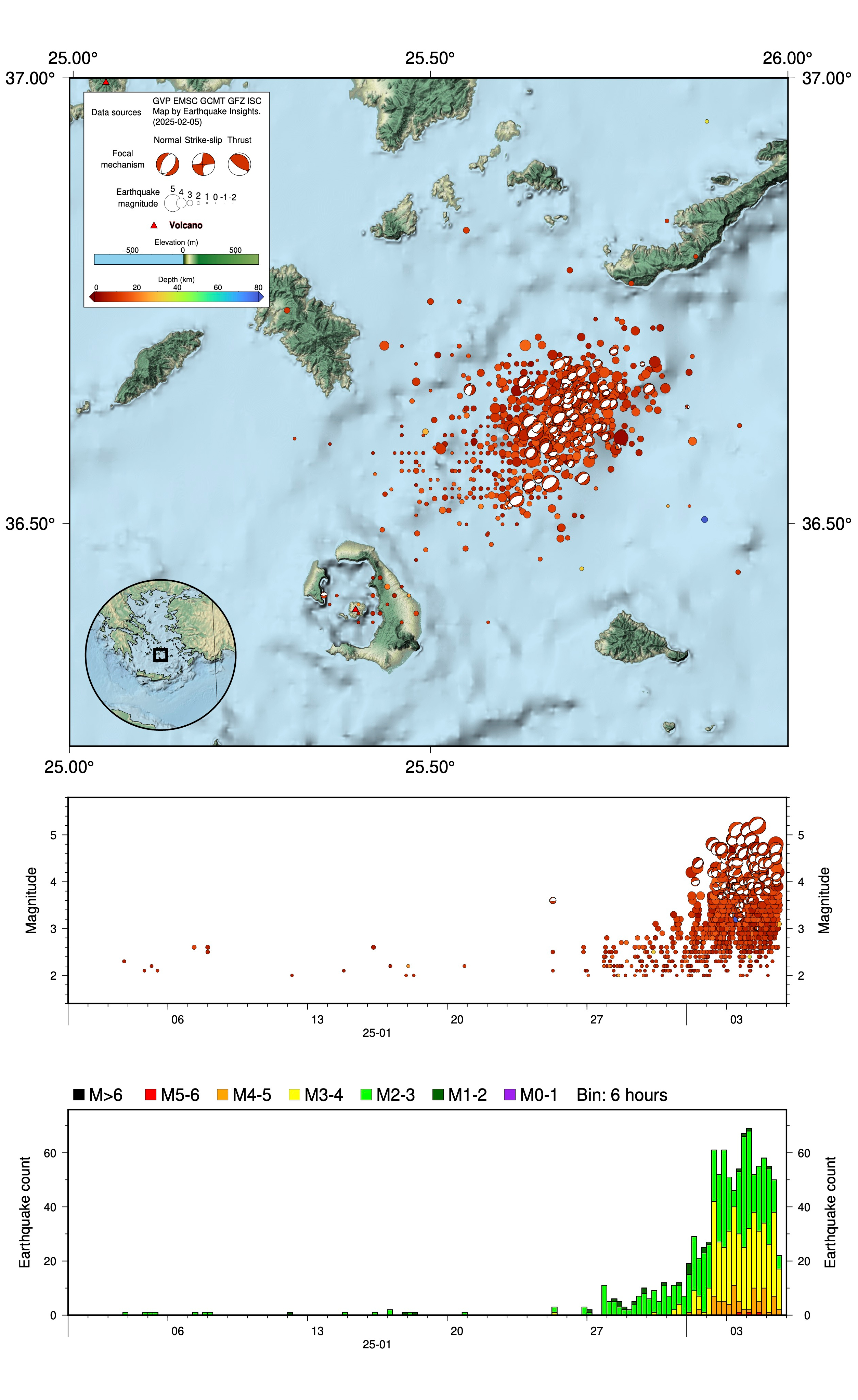
A recent seismic swarm beneath the Aegean Sea, northeast of Santorini, has drawn attention from geologists worldwide. Since January 27, a series of earthquakes has intensified, with magnitudes steadily increasing, reaching a maximum recorded M5.2 on February 4. Many residents of nearby islands, including Santorini, have voluntarily evacuated due to concerns over ongoing seismic activity. While seismicity in this region is not unusual, scientists are closely monitoring the current swarm for signs of potential escalation.
Tracking the Earthquake Swarm
The current swarm has been characterized by a persistent increase in both earthquake frequency and magnitude. Data from the European-Mediterranean Seismological Centre (EMSC) suggests that earthquake activity has remained steady since February 2, with up to 10 magnitude 4+ quakes occurring every six hours. Importantly, focal mechanisms suggest primarily normal faulting, with some strike-slip activity indicating crustal stretching in a northeast-southwest direction.
In a fortunate coincidence, a scientific team had already planned the deployment of four underwater seismographs in the area. This effort, currently underway, will improve earthquake location accuracy and may reveal additional subtle seismic signals that distant land-based stations cannot detect.
Patterns of Seismic Migration
Seismic records dating back to June 2024 indicate that while some smaller events have been recorded below Santorini, the majority of the current activity is occurring farther northeast. Since February 1, earthquake depths and distribution patterns suggest that seismicity is gradually migrating in that direction. The migration of seismicity is often associated with fluid movement within the Earth's crust, supporting the hypothesis that subsurface fluid activity may be driving this swarm.
Cross-sectional analysis of the earthquake distribution further highlights a key trend: events in the southwestern region appear to be deeper, whereas those toward the northeast are shallower. This observation aligns with the structure of the Amorgos Fault, which was responsible for a devastating M7.8 earthquake in 1956.
What Comes Next?
Seismic swarms can be unpredictable—some lead to significant earthquakes, while others gradually subside without further escalation. At present, there is no definitive indication that this swarm will trigger a larger earthquake, but the overall seismic risk in the region remains elevated. Ongoing monitoring and further analysis of fault activation patterns will provide clearer insights into how this sequence is evolving.
As researchers continue gathering data from new seismographic installations, scientists hope to refine their understanding of seismic activity in this geologically complex region. For now, the most likely scenario is that the swarm will subside without producing a major quake, though residents and officials remain on alert as the situation develops.
References
J. Hubbard and K. Bradley, Earthquake swarm beneath the Aegean Sea, Earthquake Insights, https://earthquakeinsights.substack.com/p/earthquake-swarm-beneath-the-aegean